


Myofascial Release Birmingham: What Happens to Your Fascia During Treatment
- Adrian Wildborne

- Apr 18
- 3 min read
Updated: May 4

Myofascial release is one of the most frequently used techniques in soft tissue therapy — and one of the most frequently misunderstood. Clients often ask what's actually happening during that sustained, slow pressure work, and why it feels so different to conventional massage. The answer lies in understanding fascia itself.
What is Fascia?

Fascia is a continuous web of connective tissue that surrounds and permeates every structure in the body — muscles, bones, organs, nerves, and blood vessels. It's a three-dimensional matrix that provides structural support, transmits mechanical forces, and plays an active role in movement, proprioception, and pain signalling.
For much of the 20th century, fascia was treated as inert packing material by the medical establishment. The past two decades of research have completely overturned this view. Fascia is now understood to be a dynamic, metabolically active tissue with its own nerve supply, contractile capacity, and significant role in musculoskeletal pain and dysfunction.
What Goes Wrong with Fascia?
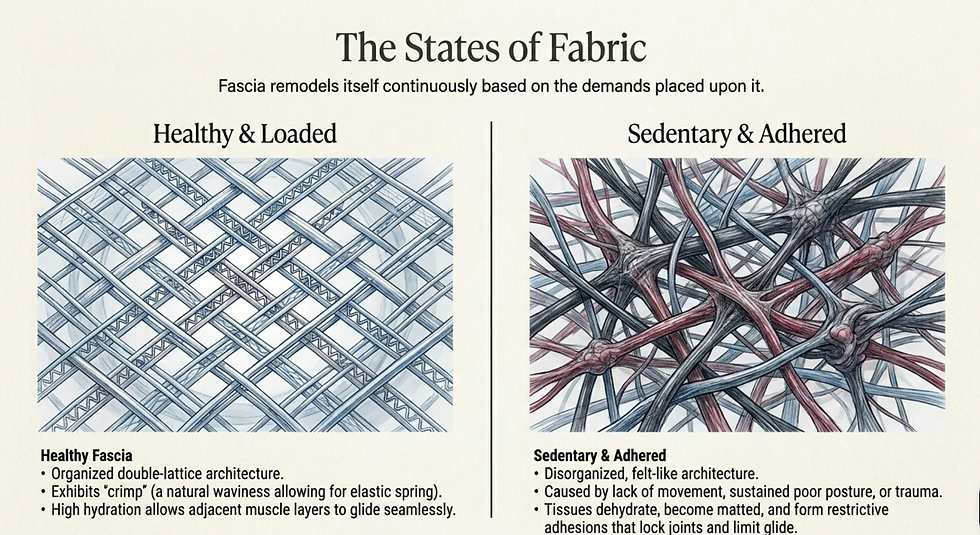
Fascial tissue can become restricted, thickened, or dehydrated through a range of mechanisms:
Injury and inflammation, which trigger fascial thickening and cross-linking as part of the healing response
Prolonged static postures (desk work, driving) that load the fascial system repeatedly in one direction
Repetitive movement patterns that create cumulative fascial stress in specific regions
Dehydration and inactivity, which reduce the viscosity of the ground substance within the fascial matrix
Emotional stress, which has been shown to increase fascial tone and trigger point activity through the autonomic nervous system
When fascia becomes restricted, it doesn't just affect local tissue mobility. Because the fascial network is continuous throughout the body, restrictions in one area can create tension and dysfunction in apparently unrelated regions — which is why a tight calf can contribute to lower back pain, or a restriction in the thoracic fascia can affect shoulder mobility.
What is Myofascial Release?

Myofascial release (MFR) is a manual therapy technique that uses sustained, low-load pressure applied to fascial restrictions to restore mobility, reduce pain, and normalise tissue function. Unlike conventional massage, which primarily works with the contractile properties of muscle, MFR targets the viscoelastic and piezoelectric properties of the fascial matrix.
The technique involves applying gentle but firm pressure into a restriction and holding it there — sometimes for 90 seconds to several minutes — until a release is felt. This 'release' represents a combination of mechanical changes (the collagen fibres reorienting and lengthening) and neurological changes (the nervous system reducing its protective holding tone in the tissue).
What Does It Feel Like?
Myofascial release feels distinctly different from deep tissue or sports massage. The pressure is typically less intense and slower, with longer holds rather than repetitive strokes. Clients often describe sensations of heat, spreading, melting, or a wave-like release as the tissue responds to the technique. Some areas of chronic restriction may produce referred sensations, tingling, or an emotional response as the tissue releases.
How is MFR Used at Functional Body Clinic?
At Functional Body Clinic in Birmingham, myofascial release is integrated into treatment as part of a broader soft tissue therapy approach. It is particularly valuable for clients with chronic pain patterns, postural dysfunction, scar tissue restrictions following injury or surgery, and presentations where conventional muscle-focused massage has provided only temporary relief.
MFR is combined with other techniques including soft tissue release (STR), trigger point therapy, muscle energy techniques (MET), and joint mobilisation to address the full picture of each client's presentation.
If you've been struggling with persistent pain, restricted movement, or conditions that haven't responded to conventional massage, myofascial release may be the missing piece. Book an initial assessment at Functional Body Clinic, Edgbaston, and we'll develop a treatment plan that addresses the root cause of your symptoms.

Further reading on fascia and soft tissue therapy
If you’d like to explore how myofascial work fits into the wider picture of treatment at Functional Body Clinic, these articles go deeper:
The Holistic Deep Tissue Plan: Beyond the Surface – how deep tissue and myofascial work combine to address chronic tension and complex pain patterns.
Trigger Point Therapy Birmingham – what trigger points are, how they relate to fascia, and how we treat them in clinic.
Maintenance Massage for Office Workers in Birmingham – how regular treatment helps counteract long hours at the desk.
What is Maintenance Massage and Why Should You Consider It? – when to move from one‑off crisis treatments to a structured maintenance approach.
Ready to see how myofascial release could help your specific presentation?
Maintenance Care Plan – Birmingham – monthly or fortnightly sessions to keep tissue health on track.


Comments